
The 2026 season has arrived. The World Baseball Classic is around the corner. And already, the low hum of a potential labor stoppage is filtering through the sport’s headlines.
There is an old proverb often repurposed in moments like this: The best time to negotiate a collective bargaining agreement was 20 years ago. The second-best time is now.
Dark clouds are gathering over the game, threatening to stall its momentum at a time of global growth and unprecedented talent. Few summed up that unease more succinctly than Bryce Harper, the face-of-the-franchise first baseman for the Philadelphia Phillies.
Appearing on 94WIP, Harper was asked whether he believes the 2027 season will begin on time. His answer was blunt.
“No.”
Pressed further — Would there be a 2027 season at all? — Harper paused but offered a measure of optimism.
“Yes,” Harper said. “I think for me personally, I want what is best for the game, for owners and players as well. Our game is at the peak of where we are at right now with so much talent. It is an international game right now, and I don’t think we want to lose that. I don’t think owners want to lose that. But we are at such a standstill right now that it is going to be tough to figure things out in a three-month span.”
That standstill arrives at a precarious moment for the Major League Baseball Players Association. In February, longtime executive director Tony Clark resigned amid an investigation into the union’s finances and revelations of an inappropriate relationship with his sister-in-law, whom he hired in 2024.
The scandal extended beyond personal misconduct.
In 2019, the MLBPA and the National Football League Players Association launched OneTeam Partners, a joint venture designed to centralize and expand players’ commercial opportunities. The platform was intended to help athletes maximize their name, image and likeness rights through a unified licensing structure.
But in 2024, a whistle-blower complaint was filed with the National Labor Relations Board, alleging that certain individuals — including Clark — used OneTeam Partners to enrich themselves and steer opportunities toward family members. What was built as a vehicle to grow players’ earnings instead became the subject of federal scrutiny.
For the union’s membership, the damage was both financial and emotional. Clark had been elected as the first Black executive director in MLBPA history and the first former player to hold the role. His departure under investigation struck at the core of the union’s identity — a brotherhood built on trust and collective strength.
The timing could hardly be worse.
The current CBA expires Dec. 1, and ownership has signaled a willingness to impose a lockout. With fewer than nine months remaining, the MLBPA is navigating a leadership transition that has already disrupted meetings and internal planning at a moment when strategic clarity is paramount.
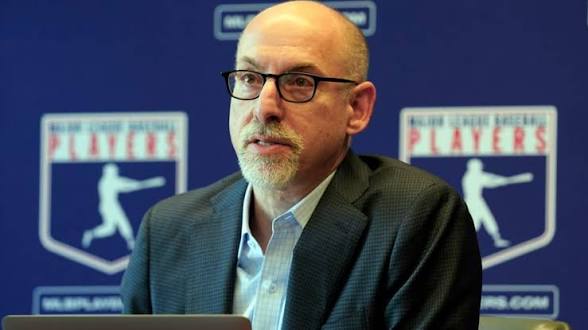
Into that vacuum steps interim executive director Bruce Meyer.
A veteran labor attorney — and not a former player — Meyer was elevated despite some players and agents having previously voiced concerns about his role in past negotiations. Now he inherits not only the responsibility of leading talks with the league but also the task of restoring trust within a union of roughly 6,700 members.
Meyer has made clear he expects a lockout once the agreement expires.
“The league has pretty much already said there is going to be a lockout,” Meyer said, per the Detroit Free Press. “I think commissioner Rob Manfred more or less guaranteed it. I would be shocked if they did not do a lockout when the agreement expires.”
At the center of the looming dispute is the issue that has defined baseball’s labor wars for decades: a salary cap and/or floor.
The MLBPA remains firmly opposed to any cap system, while some owners argue that escalating payrolls — pointing to clubs such as the Los Angeles Dodgers — have widened competitive and financial disparities across the sport. League officials counter that a cap, paired with a floor, could create greater balance.
But balance inside the union is equally complex.
Roughly 60 percent of players earn the league minimum. Minor league representatives account for 47 percent of the votes on the 72-member executive board. The average major-league career lasts fewer than six years — the service time threshold for free agency — and only about one in five rookies return for a second season.
Those economic realities shape priorities and fracture perspectives. Achieving consensus among stars, veterans, fringe roster players and minor leaguers is no small task.
Meyer must now hold that coalition together while confronting ownership across the bargaining table. He must address the fallout from the Clark investigation, reestablish credibility and chart a forward-looking strategy, all while preparing for what many around the game believe is an inevitable work stoppage.
“Our position and the historic position of this union for decades on the salary cap is well-known,” Meyer said. “It is the ultimate restriction. It is something that owners in all the sports have wanted more than anything — and baseball in particular. There is a reason for that: because it is good for them and not good for players.”
The question is not simply whether Meyer can maintain the union’s historic resistance to a cap. It is whether he can bridge widening economic divides within his own membership while navigating ownership’s appetite for structural change.
The sport stands at a crossroads — thriving globally, yet bracing for internal conflict. Whether the next chapter brings labor peace or another shutdown may hinge less on rhetoric and more on trust: rebuilt inside the union, recalibrated across the bargaining table and restored with fans who have endured this cycle before.
What are your thoughts? Let us know in the comments below! Make sure to follow The Baltimore Battery on Facebook, X, Bluesky and TikTok, and use the hashtag #baltimorebattery when sharing our content!
Represent The Baltimore Battery and show off your fandom with our official merchandise! Reasonably-priced attire made just for you! Visit our official shop site by clicking here!
Like Stephen’s content? Follow him on X – @SRJHeckman, and listen to the official podcast of The Baltimore Battery, The Final Strike, anywhere you get your podcasts!


 THE BALTIMORE BATTERY
Leave a comment