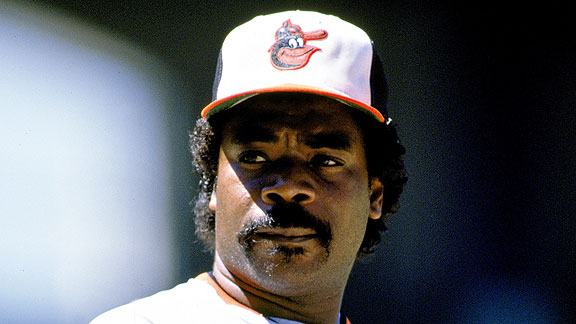

When discussing the greatest first basemen in baseball history, Eddie Murray belongs in the conversation — not only in Baltimore, but across the sport.
Nicknamed “Steady Eddie” for his calm presence at the plate, Murray led the majors with 996 RBIs during the 1980s and established himself as one of the era’s most consistent hitters.
Drafted in the third round in 1973 after batting .500 as a senior at Locke High School in Los Angeles — where he was teammates with fellow Hall of Famer Ozzie Smith — Murray debuted in the big leagues on April 7, 1977. He played 160 games as a rookie, hitting 27 home runs with 88 RBIs and became the second Black Oriole to win Rookie of the Year, joining Al Bumbry.
– 1977 AL Rookie of the Year
— MLB Network (@MLBNetwork) February 2, 2018
– 1983 @Orioles World Series Champion
– One of five members in the 3,000 hit/500 home run club
– 2003 @baseballhall inductee
Eddie Murray leads off #BlackHistoryMonth pic.twitter.com/6zBl1RfiYt
Murray was an All-Star in 1978 and from 1981–86, finishing in the top 10 of MVP voting seven times, including runner-up finishes in 1982 and 1983. He won three consecutive Gold Gloves from 1982–84 and formed a cornerstone duo with Cal Ripken Jr., helping lead the Orioles to a World Series title in 1983.
Tensions with ownership surfaced in the mid-1980s after Murray accused the club of pressuring him to return too quickly from injury. Following criticism from then-owner Edward Bennett Williams, Murray requested a trade and was dealt to the Los Angeles Dodgers in December 1988. The move was widely criticized in Charm City.
Murray returned to the Orioles in 1996 during a pennant race and helped the club reach the ALCS before falling to the New York Yankees. That September, he hit his 500th career home run, becoming one of the few players in history with 3,000 hits and 500 home runs.
Baltimore #Orioles legend Eddie Murray hits career HR #500 at Camden Yards! (1996) Happy 69th Birthday Eddie! #MLB #Baseball #History pic.twitter.com/jq0VNzRHol
— Baseball by BSmile (@BSmile) February 24, 2025
He retired after the 1997 season and later served as a coach with multiple organizations, including Baltimore. Inducted into the National Baseball Hall of Fame in 2003, Murray had his No. 33 retired by the Orioles and was honored with a statue at Oriole Park at Camden Yards in 2012.
A fierce presence in the box, who still holds the MLB record for RBIs by a switch-hitter (1,917), Murray ranks second in Orioles history in home runs and remains one of the most accomplished first basemen the game has seen.
Outside of baseball, Murray made a donation in the 1980s to the Baltimore City Parks and Recreation Department, which went to establish the Carrie Murray Nature Center, named after his late mother.
In 2008, Murray released a charity wine called Eddie Murray Wine Cabernet 504, named after the total number of home runs he hit during his career. The proceeds from the wine are donated to the Baltimore Community Foundation.
Today we honor Carrie Murray, a remarkable woman whose legacy lives on through her son, legendary #Orioles player #EddieMurray.
— Baltimore Rec & Parks (@RecNParks) February 14, 2025
In a beautiful act of love, Eddie donated funds to Rec & Parks to dedicate the Carrie Murray Nature Center. 💕 #BlackHistoryMonth #CarrieMurray pic.twitter.com/BF6X3e9MHr
Steady Eddie was a tremendous competitor and a consistent menace at the plate, making him a top player in the history of Baltimore baseball. We celebrate him and his contributions to Birdland this Black History Month.
What are your thoughts on Eddie Murray? Let us know in the comments below! Make sure to follow The Baltimore Battery on Facebook, Twitter (X) and TikTok, and use the hashtag #baltimorebattery when sharing our content!
Represent The Baltimore Battery and show off your fandom with our official merchandise! Reasonably-priced attire made just for you! Visit our official shop site by clicking here!
Like Stephen’s content? Follow him on X – @SRJHeckman, and listen to the official podcast of The Baltimore Battery, The Final Strike, anywhere you get your podcasts!

 THE BALTIMORE BATTERY
Leave a comment